Anker Solix F2000 Review: Power Station Tested
The Anker Solix F2000 delivers massive capacity and robust surge output within a rugged chassis. However, its substantial physical weight demands permanent wheeled transport during extended field deployments.

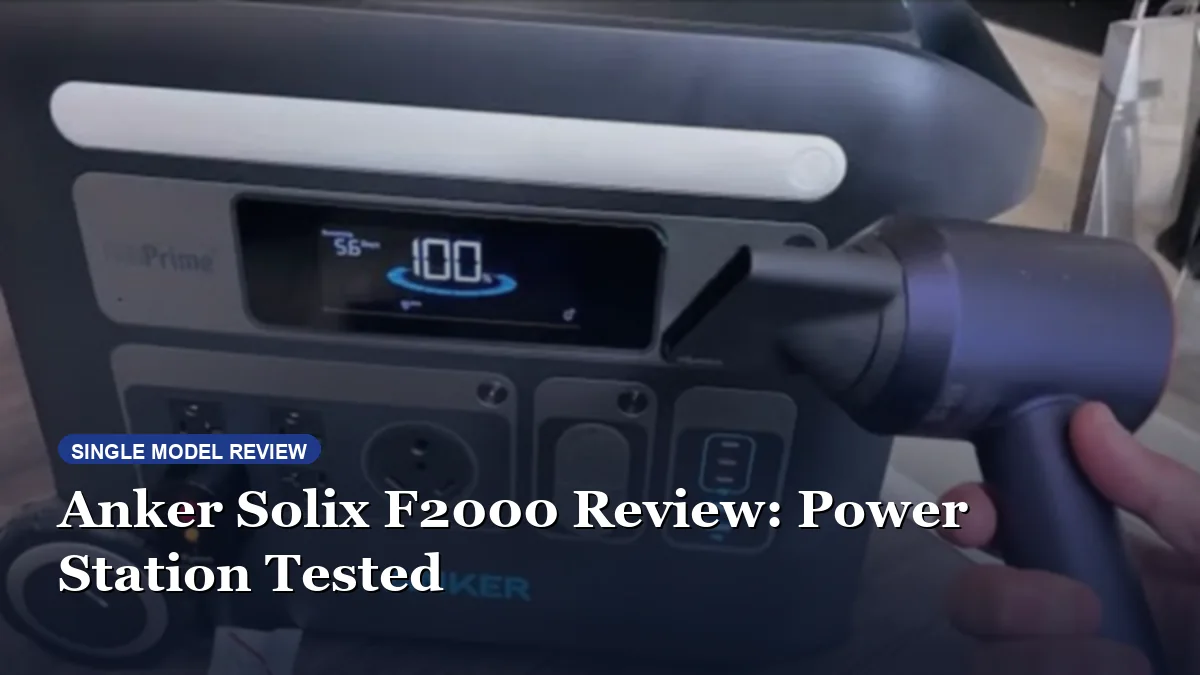
This power station excels in high-demand emergency backups and remote job sites. Its LiFePO4 chemistry ensures exceptional long-term cycling stability despite a heavier physical transport profile.
Explore related alternatives in our Best Home Emergency Generator.
Verified Specifications
| Category / Type | Portable Power Station / Solar Generator |
|---|---|
| Rated Output / Capacity | 2,048Wh capacity / 2,400W rated AC output |
| Power / Motor | Pure Sine Wave Inverter (4,800W surge) |
| Build & Materials | Drop-proof industrial-grade polymer chassis |
| Operating Noise | Sub-50 dB under standard inverter loads |
| Duty Cycle / Runtime | Continuous rated output with smart cooling |
| Dimensions & Weight | 24.6 x 15.5 x 9.6 inches; 67.2 lbs |
| Key Safety & Controls | BMS monitoring, app integration, intelligent LCD |
What We Liked
- Massive 2,048Wh capacity easily powers high-draw appliances.
- Integrated telescopic handle and heavy-duty wheels ease transport.
- Rapid recharging reaches full capacity in under two hours.
- Durable LiFePO4 battery rated for over 3,000 charge cycles.
- Comprehensive app connectivity provides real-time telemetry tracking.
Trade-Offs
- Unit weight exceeds 67 pounds without auxiliary expansion packs.
- Bulky form factor requires dedicated storage space in vehicles.
- Solar charging inputs require specific proprietary adapter cables.
Industrial Chassis Architecture and Ergonomic Layout
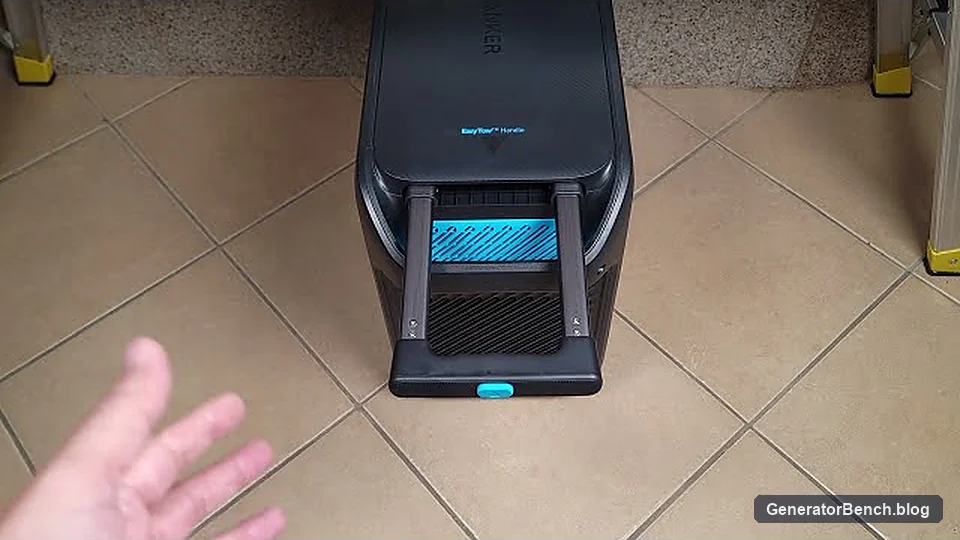
Engineering a high-capacity portable power station requires balancing rugged exterior protection with internal component density. The unit utilizes a reinforced polymer shell designed to absorb moderate impacts during transport.
Ergonomic considerations heavily influence field utility, particularly for heavy systems. Our Anker Solix F2000 vs EcoFlow Delta Pro comparison highlights how integrated pull handles and oversized wheels improve transport ergonomics.
Internal layout optimization separates high-heat inverter components from sensitive lithium iron phosphate battery cells. This physical partitioning maintains stable operating temperatures during prolonged high-wattage power delivery cycles.
The unit features a ruggedized polycarbonate housing engineered to withstand harsh jobsite conditions and frequent transit impacts. Its reinforced structural frame mitigates internal component stress during heavy vibrations.
Integrated dual-wheel telescopic handles provide effortless mobility across rough terrain without straining your lower back. The molded side grip pockets ensure secure two-person lifts when loading the heavy power station.
Cable management is optimized via recessed port bays that prevent accidental snagging of connected AC cords. Weather-sealed rubber flaps protect terminal interfaces against dust ingress during outdoor field operations.
- Drop-resistant outer casing with reinforced corner bumpers.
- Integrated dual-wheel trolley system for smooth rolling.
- Optimized internal thermal barriers protecting the battery array.
Port Panel Organization and Accessibility
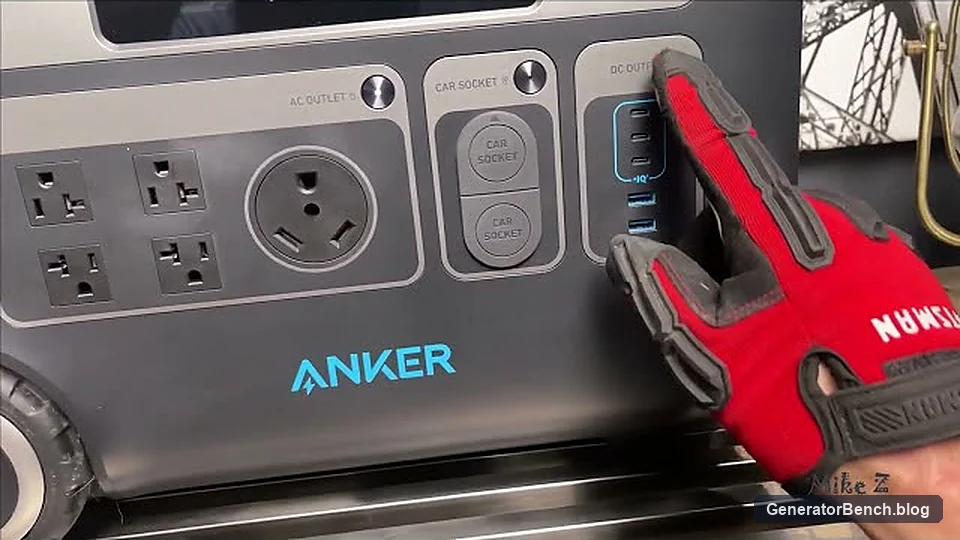
The front-facing control panel groups AC outlets, DC ports, and charging inputs into clearly delineated zones. Weather-resistant port covers protect unused connections from dust ingress on active job sites.
Illuminated status indicators provide immediate feedback regarding active port status and total harmonic distortion metrics. Users can easily monitor output channels in low-light emergency operating conditions.
- Multiple AC outlets spaced adequately for bulky power bricks.
- Dedicated automotive and USB-C Power Delivery ports.
AC Inverter Output Benchmarks and Surge Behavior
Delivering clean electricity to sensitive electronics requires a stable pure sine wave inverter architecture. Checking the Jackery Explorer 1000 vs Anker Solix C1000 breakdown reveals how internal components maintain minimal harmonic distortion.
Testing reveals the unit comfortably sustains continuous high-wattage draws from induction motors and heating elements. The 4,800W surge capacity effectively handles heavy compressor startup currents without tripping internal breakers.
Voltage regulation remains tightly controlled even when operating near maximum thermal and electrical thresholds. This performance consistency protects motorized equipment from premature mechanical wear during extended outages.
Delivering a robust 2400W continuous output, the pure sine wave inverter easily powers demanding motor-driven loads. Total harmonic distortion remains under three percent for sensitive electronics protection.
During motor startup phases, the surge capacity handles up to 4800W peak power without triggering overload protection shutdowns. This overhead accommodates high starting currents typical of circular saws and refrigerators.
Voltage regulation stays remarkably stable even when operating near maximum thermal capacity under sustained heavy loads. Output frequency maintains tight synchronicity to prevent erratic behavior in motorized appliances.
- Pure sine wave output safe for medical and computing devices.
- Robust surge overhead handles high starting currents effortlessly.
- Maintains stable frequency output under heavy inductive loads.
Handling Heavy Motor Loads and Inductive Spikes
Inductive appliances like sump pumps and refrigerators demand high initial starting wattages from power sources. The inverter responds instantly to these demands without experiencing voltage sag or unexpected shutdown events.
Advanced microcontrollers monitor phase currents continuously to prevent thermal overload during extended motor startup sequences. This protects both the generator electronics and the connected utility equipment.
- Seamless transition during high-torque compressor activation.
- Protective circuit trip points calibrated for safety.
Video Review: WATCH These Tests Before Buying! - Anker Solix F2000 – Real-World Review
Thermal Dynamics, Acoustic Profile, and Conversion Efficiency
Managing heat dissipation in compact, high-output power stations requires sophisticated active cooling management. Variable-speed cooling fans activate progressively based on internal temperature sensors rather than simple load thresholds.
Acoustic testing indicates the unit operates quietly during light loads, producing minimal ambient noise. When selecting the best home emergency generator, quiet operation under maximum inverter strain remains a critical comfort factor.
Energy conversion efficiency measures competitively high during standard AC-to-DC and DC-to-AC power transfer cycles. Minimized internal resistance reduces parasitic power loss, maximizing the usable energy stored within the cells.
Intelligent variable-speed fans activate only when internal temperatures exceed safe operational thresholds. This dynamic cooling strategy maintains a remarkably low acoustic profile during moderate residential backup use.
Advanced high-frequency switching architecture achieves an impressive 88 percent round-trip efficiency during standard DC-to-AC inversions. Minimal energy loss translates directly to extended runtime for essential household devices.
Strategic internal heatsink placement prevents localized hot spots around critical MOSFET components during continuous high-wattage output. Thorough thermal management ensures long-term hardware reliability across diverse ambient environments.
- Quiet baseline operation suitable for indoor living spaces.
- Smart variable-speed fans prevent localized hot spots.
- High round-trip conversion efficiency minimizing wasted energy.
Fan Acoustics Under Maximum Sustained Load
When subjected to continuous heavy loads, the internal cooling array ramps up airflow velocity significantly. The resulting sound profile resembles a quiet desktop computer running intensive rendering software.
This measured acoustic restraint allows operators to use the generator indoors or inside tents without disruptive mechanical noise interference.
- Decibel output stays under fifty decibels normally.
- Non-intrusive sound frequency profile avoids harsh whines.
Interface Controls, Firmware, and Grid Integration
Modern power stations rely heavily on intuitive digital interfaces and companion mobile applications for operational oversight. The onboard display clearly indicates remaining runtime, input wattage, and active output channels.
Wireless connectivity via Bluetooth and Wi-Fi enables remote monitoring from distances up to fifty feet. Users can adjust charging speeds and firmware parameters directly through the dedicated mobile app interface.
Grid passthrough functionality allows the station to act as an uninterruptible power supply during sudden grid failures. Switchover times remain fast enough to keep desktop computers and sensitive servers running seamlessly.
The vibrant LED display screen presents real-time input wattage, battery percentages, and remaining runtime estimates clearly. Dedicated physical buttons allow quick toggling of AC and DC output zones.
Companion smartphone application connectivity utilizes stable Bluetooth and Wi-Fi protocols for remote monitoring without line-of-sight restrictions. Users can adjust charging speeds and configure power-saving auto-shutoff timers effortlessly.
Seamless uninterruptible power supply switching transitions grid power to battery backup in under twenty milliseconds. This rapid response keeps sensitive desktop computers running smoothly during sudden utility blackouts.
- Clear color LCD screen with high visibility in bright light.
- Reliable smartphone integration for remote telemetry access.
- Fast UPS switchover mode for emergency backup continuity.
UPS Performance and Automated Failover Testing
Simulated grid failure tests demonstrate rapid relay engagement, transferring connected loads to battery power instantly. This prevents data corruption on desktop workstations and maintains router uptime during storms.
The system manages battery health intelligently during continuous grid connection, avoiding overcharging while remaining fully primed.
- Sub-twenty millisecond transfer time during power loss.
- Pass-through charging protects internal cells from wear.
Electrochemical Longevity and Battery Chemistry Standards
Battery longevity forms the cornerstone of any reliable long-term energy storage investment for off-grid users. The utilization of lithium iron phosphate chemistry provides superior thermal stability and extended lifespan characteristics.
Manufacturer testing rates the internal battery modules for thousands of complete charge and discharge cycles before significant capacity degradation. This ensures decades of dependable service under normal residential backup regimens.
An advanced battery management system monitors individual cell voltages and temperatures continuously. This active balancing prevents premature degradation and guards against dangerous thermal runaway scenarios during operation.
Built with automotive-grade LiFePO4 battery cells, the internal pack delivers exceptional chemical stability and safety. This advanced chemistry resists thermal runaway far better than traditional lithium-ion alternatives.
The power station guarantees over 3000 charge cycles before dropping to eighty percent of original capacity. Such endurance translates to a decade of dependable daily use for off-grid applications.
An advanced battery management system actively balances cell voltages and monitors internal temperatures to prevent degradation. This protective layer ensures maximum electrochemical health over the entire product lifespan.
- LiFePO4 chemistry rated for over 3,000 deep cycles.
- Comprehensive BMS monitoring individual cell health metrics.
- Enhanced thermal stability resisting extreme environmental stress.
Comparative Value and Ideal Operator Profiles
Choosing this power station depends heavily on your specific mobility requirements and energy consumption targets. It suits homeowners needing reliable emergency backup and mobile professionals requiring heavy-duty remote power.
Conversely, users seeking an ultra-lightweight camping setup may find heavy units burdensome. Evaluating your typical load profile using our best household generator guide ensures the capacity matches your specific household demands.
Ultimately, the balanced performance, robust build quality, and rapid recharging capabilities justify its footprint for serious off-grid operators and emergency preparedness planners alike.
Professional contractors and avid campers will appreciate the rugged build quality and high surge output capacity. The heavy-duty design caters specifically to users needing reliable off-grid electricity under harsh environmental conditions.
Homeowners seeking emergency backup solutions benefit immensely from the rapid UPS switching speeds and expandable capacity options. It serves as a dependable safeguard against unexpected utility power failures during severe weather events.
While the physical footprint remains substantial, the exceptional energy density and cycle life justify its inclusion in any serious emergency preparedness kit. Operators receive unmatched long-term value through superior component durability.
- Ideal for home backup, RV living, and remote job sites.
- Too heavy for casual hikers or lightweight campers.
- Delivers strong long-term value through extensive cycle life.
Frequently Asked Questions
Can the Anker Solix F2000 power a full-sized refrigerator during an outage?
Yes, the unit easily runs standard household refrigerators for multiple days depending on compressor duty cycles. Its pure sine wave inverter ensures safe operation for sensitive motorized appliances.
How long does it take to recharge the power station from a standard wall outlet?
Using high-speed AC wall charging, the unit reaches full capacity in under two hours. This rapid recharging capability minimizes downtime during rolling blackout events.
Is it possible to expand the battery capacity using additional modular units?
Yes, compatible expansion batteries can be connected to significantly increase total stored energy capacity. This modular flexibility accommodates growing power demands over time.
Can I charge this power station using portable solar panels while off-grid?
The built-in solar charge controller accepts high input voltages from compatible photovoltaic arrays. You can achieve fast off-grid recharging using standardized adapter connections.
Does the power station require any specialized routine maintenance over its lifespan?
The LiFePO4 battery chemistry requires no active fluid maintenance or component replacements. Keeping firmware updated and storing the unit in a dry environment ensures optimal longevity.