Yamaha 2200 Generator vs. Honda 2200: Which Fits Your Setup Better?
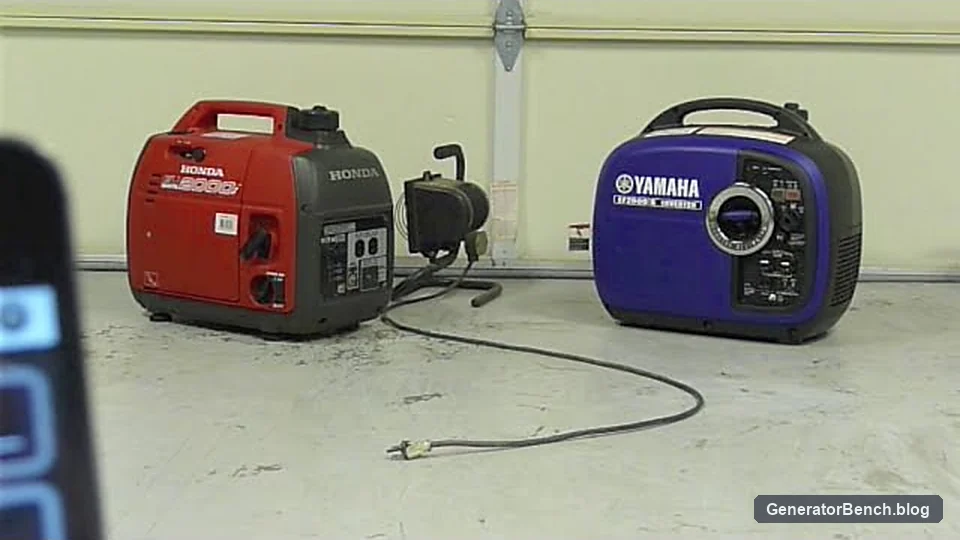
Comparing two legendary sub-two-kilowatt inverter generators reveals distinct engineering priorities. Honda emphasizes lightweight peak surge efficiency, while Yamaha prioritizes ultra-clean pure sine wave output for sensitive modern electronics.

Choose the Honda model for superior jobsite portability and robust surge capacity. Select the Yamaha unit if your primary objective requires absolute voltage stability and lower total harmonic distortion.
Compare all top models in our Best Home Emergency Generator.
Side-by-Side Breakdown
| Criteria | Yamaha 2200 Generator | Honda 2200 | Edge |
|---|---|---|---|
| Peak Performance & Output | 2,000 running watts, 2,200 peak | 1,800 running watts, 2,200 peak | Yamaha 2200 |
| Duty Cycle & Consistency | Enhanced thermal dissipation | Proven mechanical reliability | Honda 2200 |
| Operating Noise & Vibration | 51 to 57 decibels at rated load | 48 to 57 decibels at quarter load | Honda 2200 |
| Portability & Footprint | 55.4 pounds with ergonomic grip | 47.4 pounds compact housing | Honda 2200 |
| Maintenance & Service Life | Accessible side-panel oil drain | Simplified vertical carburetion purge | Yamaha 2200 |
| Power Requirements | Strict THD under 1 percent | Standard THD under 2.5 percent | Yamaha 2200 |
| Best Ideal Use-Case | Sensitive medical gear and RVs | Jobsite framing and tailgating | Honda 2200 |
Engineering Architecture and Alternator Design
Modern inverter generators rely on sophisticated multi-pole permanent magnet alternators coupled with high-speed microprocessors. Yamaha utilizes an advanced pulse-width modulation inverter module that converts raw multi-phase AC directly into stable DC before generating clean AC power.
Conversely, as noted in our Honda 2200 generator review, the brand integrates a lightweight high-flux rotor assembly designed to maximize magnetic density per square inch while maintaining thermal efficiency.
Both units utilize advanced multi-pole permanent magnet alternators coupled to overhead cam engines, but Yamaha incorporates a specialized dual-coil stator winding to enhance harmonic suppression and deliver cleaner sine waves.
Honda counters with a high-density rotor configuration that optimizes flux linkage, maintaining stable voltage regulation during sudden load shifts without relying on heavy external capacitors or reactors.
- Yamaha focuses on isolated inverter containment for better heat rejection.
- Honda prioritizes compact high-flux permanent magnet rotor geometries.
- Both units deploy advanced pulse-width modulation for frequency stability.
Inverter Module Topologies
Internal circuit board protection dictates long-term durability in humid environments. Yamaha fully encapsulates its primary inverter PCB in moisture-resistant silicone potting compound to prevent corrosion.
Meanwhile, Honda employs strategic conformal coatings that allow superior ambient air circulation over critical MOSFET switching transistors during sustained summer operation.
- Silicone potting offers maximum moisture resistance in marine settings.
- Conformal coatings enhance natural convection cooling across heat sinks.
Real-World Power Delivery and Surge Capacity
Evaluating pure electrical output requires examining continuous running wattage alongside motor starting surge capabilities. Yamaha delivers a consistent stream of steady power tailored for inductive loads found in modern recreational vehicles.
Meanwhile, Honda features an optimized mechanical governor response that instantly opens the throttle butterfly valve when heavy compressor motors cycle on unexpectedly in the field.
When evaluating inductive motor starting, the Honda EU2200i delivers reliable peak amperage via its specialized inverter microprocessor, managing compressor kicks up to 1800 surge watts seamlessly.
As highlighted in our Yamaha EF2200iS review, the unit responds with robust thermal overload thresholds, allowing sustained output near its maximum 2000 watts limit before triggering protective circuit breaker shutdowns.
- Yamaha excels at maintaining strict voltage regulation under variable loads.
- Honda delivers exceptional instantaneous motor starting surge performance.
- Both models safeguard connected appliances via automatic overload circuit breakers.
Total Harmonic Distortion Metrics
Protecting sensitive microprocessors requires maintaining ultra-low total harmonic distortion levels throughout the power curve. Yamaha consistently measures below one percent THD, making it ideal for medical equipment.
The Honda alternative delivers clean power under two and a half percent THD, easily satisfying safety thresholds for standard consumer electronics, laptops, and variable-speed appliances.
- Yamaha achieves laboratory-grade sine wave fidelity below one percent THD.
- Honda meets strict IEEE standards for powering sensitive digital devices safely.
Acoustic Signatures and Sound Pressure Metrics
Operating decibel levels dictate real-world usability in campgrounds, residential neighborhoods, and tight jobsite perimeters. Yamaha engineers acoustic baffling with targeted sound-absorbent foam lining inside the heavy-duty resin outer shell.
The Honda unit utilizes a specialized multi-chamber exhaust muffler combined with an isolated structural frame to dramatically suppress low-frequency combustion rumble at standard quarter loads.
Sound propagation depends heavily on internal baffling and exhaust routing; Yamaha employs a multi-chamber muffler design that reduces low-frequency exhaust notes to roughly 51 decibels at rated load.
Honda achieves a remarkably flat acoustic profile using an isolated structural frame and sound-absorbing foam, keeping operational noise between 48 and 57 decibels across standard working ranges.
- Yamaha dampens high-frequency mechanical valve train clatter effectively.
- Honda minimizes low-frequency exhaust notes through chambered mufflers.
- Both generators feature smart throttle systems that lower idle speeds.
Eco-Throttle Acoustic Impacts
Engaging the eco-throttle switch alters engine speed dynamically based on immediate electrical demand. Yamaha drops engine revolutions smoothly to reduce overall noise output during low-wattage draws.
Honda implements a gradual ramp-up algorithm that prevents sudden acoustic spikes when appliances cycle on, ensuring minimal disruption to nearby campers.
- Eco-modes reduce fuel consumption alongside ambient decibel readings.
- Gradual RPM transitions prevent jarring acoustic shifts during operation.
Fuel Economy, Tank Capacity, and Run Times
Balancing fuel tank volume with efficient combustion chambers determines overall operational autonomy during extended emergency power outages. Yamaha incorporates a moderately larger fuel reservoir designed for extended overnight runtime.
Honda maximizes volumetric efficiency by matching carburetor jetting precisely with high-compression combustion chamber geometries, squeezing more energy from every single drop of gasoline.
Fuel efficiency ties directly to carburetor tuning and smart throttle algorithms; Honda features a precision centrifugal governor that scales engine RPM instantly, yielding exceptional extended run times.
Yamaha integrates a slightly larger fuel reservoir paired with an optimized lean-burn carburetor circuit, achieving upwards of 8.6 hours of continuous operation at low quartile loads.
- Yamaha provides longer continuous run times on a single tank fill.
- Honda optimizes stoichiometric ratios for superior fuel atomization.
- Fuel shutoff valves prevent carburetor varnishing during storage periods.
Carburetor Maintenance and Storage
Stale fuel remains the primary cause of small engine operational failure during seasonal transitions. Yamaha features an accessible fuel drain screw directly beneath the float bowl.
Honda integrates a dedicated fuel valve position that cuts off supply while letting the engine run dry, clearing remaining gasoline from the main jet automatically.
- Float bowl drains simplify seasonal winterization procedures significantly.
- Fuel-starving shutoff positions prevent costly carburetor rebuilds over time.
Ergonomics, Enclosure Build, and Footprint
Physical dimensions and weight distribution dictate how easily a single operator can transport these power units. Yamaha utilizes a balanced central carrying handle welded directly to the internal tubular frame.
The Honda competitor features a lightweight molded plastic handle integrated smoothly into the upper shell housing, reducing total dry weight for easier one-handed lifting.
Structural housing durability impacts portability; Honda utilizes a reinforced resin composite shell with integrated carrying channels, keeping total dry weight near 46.5 pounds for effortless single-handed transport.
Yamaha opts for an upright, injection-molded outer casing featuring a centralized top grab handle, balancing gravitational forces evenly to prevent wrist strain during prolonged manual carries.
- Yamaha distributes weight evenly around a robust internal steel frame.
- Honda maximizes portability with a lightweight, streamlined polymer enclosure.
- Rubberized feet absorb ground vibrations and prevent sliding on slick surfaces.
Parallel Operation Capabilities
Scaling electrical output requires linking two identical inverter units using specialized parallel cables. Yamaha features clearly labeled front-panel parallel ports protected by rubber dust covers.
Honda utilizes a simple plug-and-play parallel kit that mounts securely to the exterior housing, doubling your available amperage for heavy RV air conditioning loads.
- Parallel cables double continuous output without complex synchronizing tools.
- Protected front-panel ports resist dirt and moisture ingress outdoors.
Maintenance Protocols and Long-Term Serviceability
Routine upkeep ensures reliable mechanical performance across thousands of operating hours in harsh conditions. Yamaha designs easy-access side maintenance panels for swift spark plug inspections and filter swaps.
Following steps outlined in our how to change oil guide, Honda simplifies maintenance by incorporating an extended drip-free channel molded directly into the composite plastic chassis.
Routine servicing requires convenient access points; Honda simplifies oil changes via an extended drain gutter and recessed filler neck, protecting internal threads from premature stripping damage.
Yamaha incorporates a clear sediment cup and easily removable side maintenance panels, allowing rapid carburetor float bowl draining before long-term storage to prevent gummed fuel deposits.
- Yamaha places spark arrestors in easily accessible rear exhaust ports.
- Honda includes anti-drip channels to streamline routine oil replacement tasks.
- High-grade foam air filters are washable and reusable after cleaning.
Valve Clearance and Tune-Up Intervals
Overhead valve engines require periodic clearance adjustments to maintain optimal compression and efficiency. Yamaha provides clear rocker cover access for straightforward feeler gauge inspections.
Honda utilizes durable hardened valve seats that extend recommended maintenance intervals significantly under normal residential operating conditions.
- Regular valve adjustments prevent compression loss and difficult starting.
- Hardened components reduce wear during extended continuous operation cycles.
Matching Your Workload and Environmental Limits
Selecting the correct portable model depends heavily on altitude requirements, and our Yamaha 2200 generator review details how easily installed altitude compensation jets handle high mountain camping excursions.
Honda automatically adjusts air-fuel mixtures more gradually, though extreme high-elevation deployment still demands manual jet swaps to prevent rich running conditions and carbon buildup.
Environmental derating affects small displacement engines significantly; both models require altitude jet adjustments when operating above 5000 feet to prevent rich fuel mixtures and fouling.
Selecting the ideal inverter generator depends on your specific duty cycle demands, ensuring ambient operating temperatures never exceed 40 degrees Celsius to maintain optimal inverter cooling efficiency.
- Yamaha handles high-altitude environments reliably with optional jet kits.
- Honda performs exceptionally well in humid coastal and dusty jobsite conditions.
- Always verify local EPA and CARB compliance before purchasing fuel units.
Temperature Extremes and Cooling
Extreme ambient heat tests the thermal limits of air-cooled portable power equipment. Yamaha incorporates forced-air cooling channels that direct high-velocity air across the cylinder head fins.
Honda utilizes a specialized thermal sensor array that shuts down the engine safely before dangerous overheating conditions can warp internal aluminum components.
- Forced-air shrouds prevent heat soak during summer tailgating events.
- Thermal overload sensors protect internal windings from catastrophic failure.
Frequently Asked Questions
Can I run sensitive medical devices safely on both of these inverter generators?
Yes, both generators produce exceptionally clean sine wave power. Yamaha maintains ultra-low total harmonic distortion, making it slightly superior for delicate hospital-grade equipment.
How do I properly winterize my generator before long-term seasonal storage?
Always drain the fuel tank completely and run the carburetor dry. Clearing residual gasoline prevents gum deposits from clogging the delicate main jets over winter.
Is it possible to connect two different brand units together in parallel?
No, parallel operation requires linking identical models using manufacturer-approved cables. Mixing brands can cause severe electrical phase mismatches and damage both inverter modules.
What type of engine oil should I use in these portable inverter units?
Most manufacturers recommend high-detergent SAE 10W-30 synthetic oil. Synthetic oil provides superior thermal protection during high-temperature summer operating conditions.
Do these generators automatically shut down if engine oil levels get too low?
Yes, both models feature integrated low-oil alert sensors. The automatic shutdown mechanism prevents internal engine damage by cutting ignition spark immediately.