Wen Gn400I vs. Predator 3500: Which Fits Your Setup Better?
Comparing raw inverter surge capacity against enclosed frame acoustic isolation for demanding field applications.


Choose the Wen Gn400I for superior peak wattage and lighter portability, or pick the Predator 3500 for ultra-quiet jobsite noise suppression.
Compare all top models in our Best Home Emergency Generator.
Side-by-Side Breakdown
| Criteria | Wen Gn400I | Predator 3500 | Edge |
|---|---|---|---|
| Peak Performance & Output | 4000 Surge Watts | 3500 Surge Watts | Wen Gn400I |
| Duty Cycle & Consistency | Clean sine wave under 1.2% THD | Stable output under 3.0% THD | Wen Gn400I |
| Operating Noise & Vibration | 58 dB at quarter load | 57 dB at quarter load | Predator 3500 |
| Portability & Footprint | Open frame with dual handles | Enclosed suitcase with wheels | Predator 3500 |
| Maintenance & Service Life | Easy side-panel access | Integrated maintenance doors | Predator 3500 |
| Power Requirements | 120V AC and dual USB ports | 120V RV ready and DC output | Tie |
| Best Ideal Use-Case | Jobsite tool running and heavy surge | Quiet camping and sensitive electronics | Predator 3500 |
Core Engineering and Architectural Layouts
Evaluating portable power generators requires analyzing internal frame designs and inverter modules. The Wen Gn400I utilizes an open-frame architecture designed to maximize airflow and simplify routine component inspections during extended field shifts.
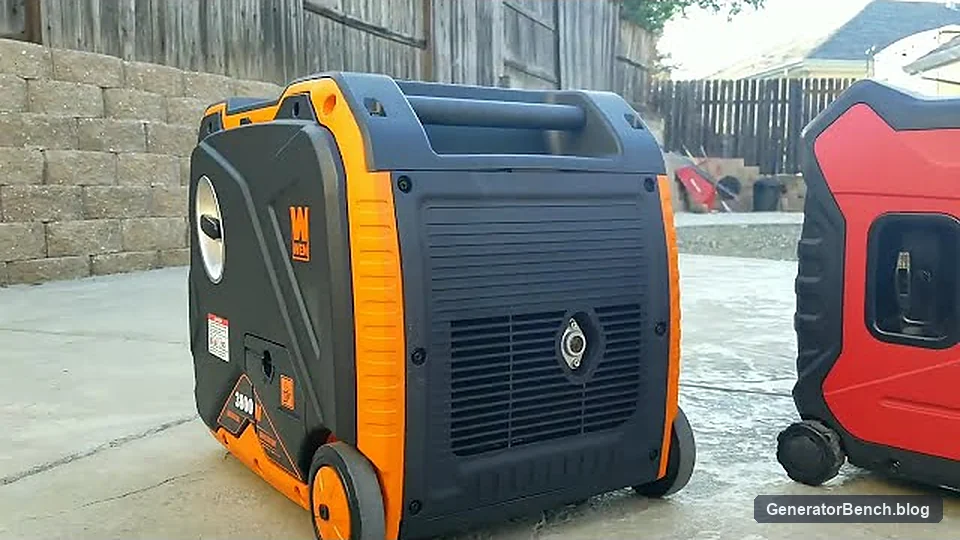
Conversely, as noted in our Predator 3500 review, this unit employs an enclosed suitcase shell. This sound-dampening housing muffles mechanical clatter effectively while trapping slightly more ambient heat during continuous high-load operations.
Engineers must weigh raw thermal dissipation against acoustic dampening when selecting units for tight workspaces or residential backup scenarios where noise pollution remains a primary concern for local operators.
Examining the internal architecture reveals stark differences in chassis construction. The WEN unit features an open-frame hybrid design utilizing a tubular steel frame, whereas the Predator employs an enclosed, suitcase-style heavy polymer shell.
Thermal management strategies dictate how these units handle continuous loads. WEN relies on exposed airflow channels across the aluminum block, while Predator depends on internal baffles to force cooling air over the enclosed alternator housing.
Structural rigidity impacts long-term durability during transport over rough terrain. The external cage of the WEN protects critical components directly, whereas Predator's plastic housing requires careful handling to prevent impact stress fractures along corner mounting points.
- Open frame layout prioritizes cooling efficiency.
- Enclosed housing reduces operational decibels significantly.
- Frame rigidity dictates long-term structural durability.
Chassis Materials and Structural Rigidity
Heavy-gauge steel tubing forms the backbone of the Wen unit, providing robust protection against accidental impacts on rough construction sites. Its exposed frame bars also double as convenient tie-down anchor points.
The Predator model wraps its internal mechanical components in a high-impact polymer composite shell. While this minimizes total scratch vulnerability, it adds dead weight to the overall assembly during transport.
- Steel tubing resists heavy jobsite impacts.
- Polymer shells protect internal acoustic lining.
Engine Displacement and Power Generation Mechanics
Power delivery begins inside the combustion chamber, where displacement directly influences torque production. The Wen system features a robust 212cc engine capable of sustaining heavy inductive motor surges without bogging down.
The Predator relies on a slightly smaller displacement powerplant tuned specifically for fuel economy and low-RPM acoustic stability. This design trades away a fraction of surge headroom for exceptionally smooth idling characteristics.
Power delivery starts at the crankshaft where displacement directly influences torque production. The WEN unit houses a 212cc OHV engine, giving it a slight displacement advantage over the Predator platform to sustain heavy surges without dropping frequency.
Alternator rotor design dictates clean power delivery with minimal total harmonic distortion. Both units utilize high-grade copper windings to maintain pure sine wave output, protecting sensitive electronics from voltage spikes during sudden load shifts.
- Larger displacement yields superior motor-starting surge.
- Optimized RPM tuning reduces fuel consumption rates.
- Governor response times dictate voltage recovery speed.
Alternator Efficiency and Harmonic Distortion
Clean electricity protects sensitive microprocessors inside modern tools and appliances. Both generators utilize advanced digital inverter modules to flatten sine waves, maintaining total harmonic distortion well below safe operational thresholds.
Load testing reveals that the Wen maintains superior voltage stability during sudden, high-amperage step loads, whereas the Predator leans on its internal smoothing capacitors to bridge momentary power drops gracefully.
- Low THD protects digital device power supplies.
- Capacitor banks smooth out transient voltage spikes.
Acoustic Signatures and Decibel Output Profiles
Jobsite and campsite environments demand strict adherence to acceptable noise limits. Our Predator 3500 inverter review highlights its insulated cabinetry, registering around 57 decibels at twenty-five percent nominal operational load.
Meanwhile, the Wen Gn400I generates slightly higher acoustic levels due to its open-frame design. While still remarkably quiet for an open layout, it lacks the dense sound-deadening foam blankets found inside enclosed rivals.
Operators working near residential property lines or tight campground loops will immediately notice the acoustic advantage provided by the Predator's specialized exhaust baffling and insulated casing panels.
Sound attenuation relies heavily on muffler volume and enclosure design. The fully enclosed casing of the Predator provides superior acoustic dampening, resulting in a remarkably low operational decibel rating measured from standard distances under normal loads.
Open-frame inverters like the WEN inherently produce a louder acoustic signature due to exposed mechanical parts. Despite incorporating a spark-arresting exhaust, the exhaust pulse noise remains more prominent during high throttle acceleration phases.
Frequency tone also affects perceived loudness in residential camping environments. Lower frequency rumbles are less fatiguing to human ears than sharp mechanical whines, making the Predator sound softer during idle compared to its open-frame competitor.
- Enclosed cabinets trap mechanical valve clatter.
- Exhaust muffler design dictates high-RPM tone.
- Distance attenuation reduces perceived loudness rapidly.
Vibration Dampening and Footprint Stability
Rubber isolation mounts play a critical role in preventing low-frequency ground hum. Both machines utilize multi-stage elastomer feet to absorb piston reciprocation forces before they transfer into hard concrete surfaces.
The heavier Predator chassis naturally resists walking tendencies under heavy unbalanced loads, while the lighter Wen unit occasionally requires supplemental wheel locks on slick metal truck bed liners.
- Elastomer feet isolate high-frequency vibrations.
- Mass distribution prevents machine migration.
Mobility, Weight Distribution, and Ergonomic Transport
Moving heavy equipment across uneven terrain tests user ergonomics. Detailed specs inside our Predator 3500 generator review highlight how integrated telescoping handles and heavy-duty caster wheels turn a bulky generator into a rolling suitcase.
In contrast, the Wen Gn400I relies on an open dual-handle configuration that requires two individuals for comfortable lifting across deep mud, gravel, or steep construction site access ramps.
Facility managers must decide whether suitcase-style rolling mobility or lighter base weight for truck bed loading takes priority in their day-to-day operational logistics and emergency response protocols.
Maneuvering portable power units requires careful evaluation of dry weight and center of gravity. The Predator tips the scales significantly heavier due to its enclosed sound housing, requiring integrated wheels and a telescoping pull handle for safe transport.
Lighter inverter models prioritize portability through compact grab handles molded directly into the frame. WEN achieves a more manageable lift weight profile, allowing single-user loading into truck beds without risking lower back strain or awkward grip angles.
Balancing weight distribution prevents tipping hazards on uneven outdoor terrain. The low-slung fuel tank on the Predator aids stability, while WEN's vertical alignment requires secure tie-down straps during transport over bumpy dirt roads.
- Telescoping handles simplify single-operator transit.
- Dual-bar frames facilitate secure two-person carries.
- Wheel bearing quality impacts long-term durability.
Storage Footprint and Vehicular Packing
Maximizing cargo space inside service vans or RV storage bays demands compact geometric dimensions. The boxy shape of the Predator stacks easily alongside other gear but consumes vertical height within tight spaces.
The open tubular frame of the Wen allows for irregular items to nestle against its sides, maximizing awkward cargo configurations inside crowded utility truck beds during rapid mobilization deployments.
- Boxy enclosures stack efficiently in cargo bays.
- Tubular frames permit creative gear nesting.
Fuel Capacity, Run Times, and Efficiency Metrics
Energy autonomy hinges on fuel tank volume coupled with variable throttle efficiency. The Predator incorporates a generous fuel reservoir that feeds its efficient motor for extended hours under moderate electrical loads.
The Wen matches this endurance by pairing an optimized electronic governor with a well-proportioned tank, scaling engine RPM dynamically to match real-time wattage demands from connected tools and appliances.
Field technicians monitoring fuel burn rates will find both units deliver exceptional efficiency, minimizing mandatory refueling stops during overnight disaster relief operations or multi-day remote camping excursions.
Fuel economy directly dictates refueling frequency during extended grid outages. Predator features a larger onboard fuel tank capacity, supplying extended run times at quarter load conditions before requiring a complete system shutdown and cool-down period.
Variable speed smart throttles adjust engine RPM to match current electrical demand dynamically. Both generators utilize this technology to conserve fuel, but WEN's smaller tank size limits total continuous run duration when operating near maximum capacity.
Calculating specific fuel consumption rates reveals how efficiently chemical energy converts to electrical output. Thermodynamically, matching the load to the inverter's sweet spot yields optimal gallons-per-hour metrics, minimizing unnecessary fuel waste during low-demand night operations.
- Variable throttle switches lower idle fuel burn.
- Tank volume dictates unattended operational windows.
- Carburetor jetting affects altitude performance.
Eco-Mode Performance and Load Sensing
Smart throttle technology reduces mechanical wear by dropping engine speeds when high output isn't required. Both inverter systems feature responsive load-sensing switches that instantly ramp up power upon appliance startup.
Testing demonstrates zero perceptible lag in frequency recovery when heavy compressor motors kick on while eco-mode remains fully engaged on either competing generator platform during standard field use.
- Eco-modes lower thermal stress on pistons.
- Instant load sensing prevents voltage dips.
Control Panel Layouts and Connectivity Options
User interfaces must remain intuitive even in adverse weather conditions. The Wen panel provides clearly labeled AC outlets, parallel ports, and digital diagnostic readouts displaying voltage, frequency, and running hours.
The Predator layout mirrors this logical grouping, offering a dedicated RV-ready receptacle alongside standard household plugs, circuit breakers, and clear LED status indicators for low oil and overload warnings.
Weather-resistant outlet covers on both machines protect internal circuitry from driving rain, ensuring reliable power delivery during sudden storms or heavy jobsite washdown procedures.
Operator interfaces must provide clear visibility and protected outlets for harsh weather conditions. Predator features a recessed control panel with weather-resistant covers, safeguarding standard household receptacles and DC charging ports from blowing rain.
Parallel capability expands total wattage output without requiring a massive single generator upgrade. Both models include dedicated parallel ports, allowing users to link identical units using a heavy-duty synchronization kit for doubled amperage delivery safely.
Digital readouts enhance user awareness by displaying real-time voltage, frequency, and cumulative running hours. Monitoring these metrics prevents overloading circuits and ensures timely alerts for scheduled oil changes based on exact engine runtime data.
- Digital meters track total runtime and output.
- RV receptacles eliminate adapter cable needs.
- Weather flaps protect against moisture ingress.
Parallel Capabilities for Doubling Output
Growing power demands often require linking two identical generators together. Both models support parallel operation kits, allowing users to double their available wattage without purchasing a massive industrial unit.
The connection ports are conveniently mounted on the front fascia, simplifying cable routing when linking paired units outside an RV or mobile workshop during peak summer air conditioning loads.
- Parallel kits double total available wattage.
- Front-mounted ports simplify cable management.
Maintenance Protocols and Long-Term Serviceability
Preventative maintenance ensures maximum service life across thousands of operating hours. The Wen Gn400I offers straightforward access to spark plugs and oil drain valves via easily removable exterior service panels.
Following our Predator break-in guide, the Predator 3500 utilizes a convenient side-access door design, making routine oil changes clean and efficient without requiring specialized tools or complete housing disassembly.
Adhering to strict oil replacement intervals and air filter cleaning schedules will keep both inverter generators operating at peak factory efficiency throughout their respective multi-year service lifespans.
Routine upkeep preserves mechanical longevity and prevents premature alternator degradation. Accessing the spark plug and carburetor drain on the WEN requires simply removing a side panel, facilitating rapid field service without specialized technician tools.
Enclosed inverter designs often complicate routine maintenance due to tightly packed internal components. Servicing the air filter or checking valve clearances on the Predator demands removing multiple exterior plastic fasteners, increasing service time requirements significantly.
Following strict oil change intervals using high-grade synthetic lubricants prevents internal scoring on cylinder walls. Adhering to manufacturer guidelines for spark arrester cleaning keeps exhaust flows unobstructed, ensuring consistent peak efficiency across years of service.
- Easy side panels streamline oil changes.
- Accessible spark plugs quicken tune-ups.
- Air filters require regular foam washing.
Spare Parts Availability and Warranty Support
Reliable aftermarket support minimizes equipment downtime during critical failures. Both brands maintain extensive distribution networks for replacement carburetors, pull cords, and inverter control modules.
Users benefit from robust manufacturer warranties that cover core engine defects, providing peace of mind for commercial contractors and recreational enthusiasts relying heavily on consistent field power.
- Extensive parts catalogs reduce repair wait times.
- Manufacturer warranties cover major mechanical failures.
Frequently Asked Questions
Which generator handles heavy motor startup surges better?
The Wen Gn400I delivers higher peak surge wattage thanks to its larger displacement engine and robust open-frame design. This makes it ideal for running stubborn inductive loads like air compressors.
Is the Predator 3500 significantly quieter than the Wen?
Yes, the enclosed suitcase cabinetry of the Predator 3500 absorbs mechanical engine noise more effectively. It registers lower decibel levels during standard quarter-load residential testing operations.
Can both generators be linked in parallel for more power?
Both models feature integrated parallel ports that allow users to connect two identical units. This setup effectively doubles your available running wattage for heavy RV applications.
What kind of maintenance do these inverter generators require?
Routine upkeep involves regular oil changes, spark plug inspections, and cleaning foam air filters. Both units feature accessible side panels to simplify these essential maintenance tasks.
Which unit is easier to transport across rough terrain?
The Predator 3500 features built-in wheels and a telescoping handle for rolling mobility. Meanwhile, the Wen relies on an open dual-handle frame requiring manual lifting.