Predator 9500 vs. Generac Gp6500: Which Fits Your Setup Better?
Comparing the ultra-quiet inverter architecture of the Predator 9500 against the rugged conventional design of the Generac GP6500. This technical guide evaluates power delivery, noise profiles, and fuel efficiency.


Choose the Predator 9500 for clean power and quiet operation, or select the Generac GP6500 for high-output jobsite durability.
Compare all top models in our Best Home Emergency Generator.
Side-by-Side Breakdown
| Criteria | Predator 9500 | Generac Gp6500 | Edge |
|---|---|---|---|
| Peak Performance & Output | 9500 Starting Watts / 7600 Running Watts | 8125 Starting Watts / 6500 Running Watts | Predator 9500 |
| Duty Cycle & Consistency | Computer-regulated inverter sine wave | Traditional open-frame alternator power | Predator 9500 |
| Operating Noise & Vibration | Enclosed acoustic cabinet design | Standard open steel frame cradle | Predator 9500 |
| Portability & Footprint | Rolling cabinet with folding handles | Tubular steel frame with pneumatic wheels | Generac Gp6500 |
| Maintenance & Service Life | Panel removal required for internal checks | Unobstructed engine block clearance | Generac Gp6500 |
| Power Requirements | Ideal for sensitive electronics and home backup | Optimized for heavy tools and jobsite loads | Predator 9500 |
| Best Ideal Use-Case | Suburban emergency backup and quiet camping | Contractor job sites and rugged utility work | Predator 9500 |
Architectural Design and Inverter Technology
As detailed in our Predator 9500 inverter generator review, the unit utilizes an advanced inverter module to deliver clean electricity, while alternatives employ open-frame designs for raw power generation.
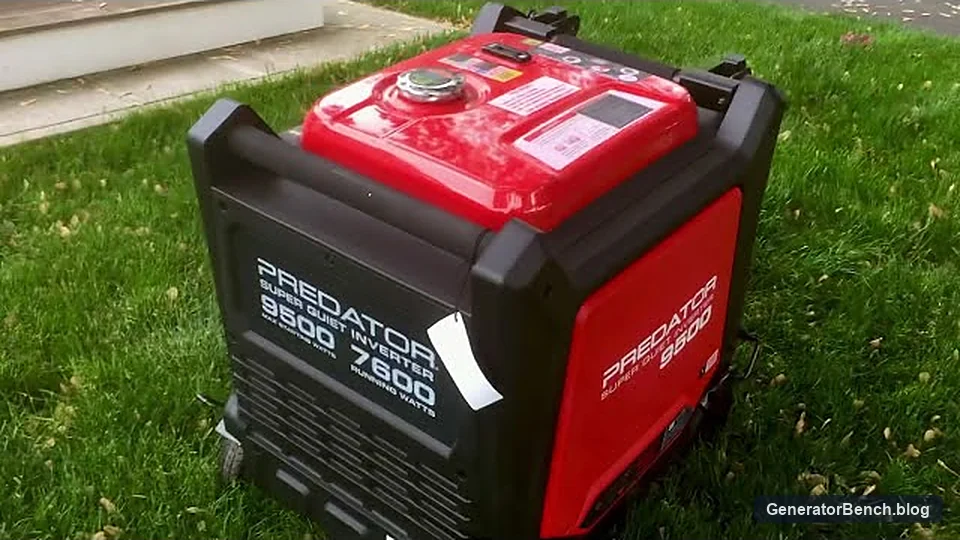
Inverter technology converts raw alternating current into direct current, then inverts it back into a stable sine wave. This protects sensitive electronics from voltage spikes during heavy residential or commercial operation.
Open-frame generators bypass complex inverter circuitry entirely, delivering raw voltage directly from the rotating alternator stator. This traditional approach maximizes electrical efficiency but sacrifices the voltage stability required by modern microprocessors.
- Pure sine wave output protects microprocessors.
- Inverter modules regulate frequency automatically.
- Traditional frames deliver direct alternator power.
Clean Sine Wave vs Traditional Alternators
Clean power is essential for modern appliances featuring microprocessors. Total harmonic distortion remains under three percent on the Predator, whereas traditional frames exhibit higher variance under sudden electrical loads.
Voltage stability prevents unexpected reboots or component degradation in smart appliances. Engineers rely on pulse-width modulation inside inverter units to guarantee consistent frequency regulation regardless of fluctuating external demand profiles.
- THD stays below three percent on inverters.
- PWM maintains steady frequency regulation.
Circuit Protection and Overload Management
Modern generator panels incorporate advanced digital circuit breakers to prevent catastrophic overloads. The Predator monitors real-time wattage draw, tripping safely before thermal runaway damages the internal alternator windings.
Generac utilizes standard thermal magnetic breakers that respond rapidly to short circuits. This reliable mechanical protection safeguards the alternator head during heavy construction tool startups and continuous jobsite operations.
- Digital meters monitor real-time wattage draw.
- Thermal breakers protect against short circuits.
Engine Performance and Starting Watts
As highlighted in our Predator 9500 review, engine displacement dictates how well each machine handles heavy surge demands. The unit relies on a specialized 420cc OHV powerplant built for endurance.
Starting large motor loads requires significant initial amperage. Both units manage heavy residential appliances, but their peak wattage ratings cater to different duty cycles and electrical demand profiles across varied environments.
Thermal management plays a critical role in sustaining maximum output over hours of continuous operation. Both engines incorporate forced-air cooling fins designed to dissipate combustion heat effectively under heavy loads.
- Displacement directly influences torque delivery.
- Forced-air cooling prevents thermal breakdown.
- Surge ratings handle large compressor motors.
Surge Capacity and Motor Starting
High starting wattage is essential for cycling residential central air conditioners or well pumps. The Predator delivers substantial surge capacity through electronic assistance, while the Generac leverages raw mechanical inertia.
Voltage sag during motor startup can stall connected compressors if recovery is too slow. Both units feature rapid governor response times to stabilize output voltage within acceptable limits during heavy surges.
- Electronic assistance boosts initial surge watts.
- Rapid governors prevent compressor stalling.
Displacement and Torque Curves
Larger engine displacements produce greater torque at lower operating RPMs. The Predator 420cc platform generates abundant torque effortlessly, reducing mechanical strain during peak electrical demand spikes.
Generac optimizes its 389cc powerplant for reliable power delivery across standard operating ranges. This engineering balance ensures consistent fuel combustion and steady performance during demanding commercial work sessions.
- 420cc engine reduces high-load mechanical strain.
- Optimized powerbands ensure steady combustion.
Fuel Efficiency and Tank Capacity
According to findings in our Predator 9500 watt generator reviews, runtime capabilities depend directly on tank volume and load-sensing throttles. The model features a 6.6-gallon tank paired with an eco-mode.
Conversely, the Generac utilizes a 7.2-gallon tank designed to sustain longer continuous intervals at higher output thresholds. Its governed engine maintains constant speed regardless of fluctuating residential or jobsite loads.
Maximizing operational intervals during prolonged emergencies requires careful fuel management strategies. Operators must balance electrical loads against tank capacity to ensure uninterrupted power delivery through extended weather events.
- Eco-mode scales RPM to active power draws.
- Larger tanks extend continuous runtime hours.
- Throttle modulation conserves fuel efficiently.
Eco-Mode and Variable Throttle Systems
Variable speed throttling drastically reduces fuel consumption during periods of low electrical demand. The Predator automatically scales back engine RPM when household appliances enter standby or idle states.
Traditional generators lack variable throttle capability, forcing engines to run continuously at three thousand six hundred RPM. This constant high-speed operation burns more fuel even when minimal electrical power is required.
- Variable throttling lowers idle fuel burn.
- Constant RPM operation increases gasoline usage.
Extended Run-Time Calculations
Calculating exact run-time requires evaluating fuel burn rates at fifty percent and maximum loads. The Predator achieves impressive efficiency figures due to its computerized inverter throttle modulation during partial load operations.
Generac compensates for constant high-speed operation by providing a slightly larger fuel capacity. This engineering trade-off ensures competitive runtime hours despite the lack of automated variable speed throttling technology.
- Computerized modulation improves partial load runtimes.
- Larger fuel reserves offset constant speed burn.
Noise Emission and Sound Levels
Acoustic engineering separates enclosed inverters from traditional open-frame generators. The Predator operates inside a fully insulated housing, registering a remarkably low decibel rating that prevents neighborhood disruption during night outages.
Traditional open frames like the Generac lack sound-dampening enclosures, resulting in a higher decibel output during standard operations. Users must position these units further away from living spaces to maintain acceptable acoustic comfort.
Sound pressure levels drop significantly with distance, but enclosure design remains the primary factor. Acoustic baffling inside inverter cabinets absorbs high-frequency mechanical noise before it escapes into the surrounding environment.
- Insulated housings absorb high-frequency noise.
- Open frames require distant placement setups.
- Baffling reduces overall decibel output.
Decibel Ratings and Neighborhood Compliance
Operating generators near residential properties requires strict adherence to local noise ordinances. The Predator maintains a quiet acoustic footprint that easily complies with typical suburban nighttime decibel restrictions.
Analyzing insights from our Generac GP6500 review, standard open-frame models generate substantial noise levels that can disturb neighbors during outages. Users frequently construct acoustic barriers to mitigate sound propagation.
- Quiet footprints comply with suburban ordinances.
- Open frames often require custom acoustic walls.
Enclosure Design and Sound Dampening
Molded plastic enclosures with acoustic foam lining effectively trap mechanical vibration and exhaust sound. The Predator utilizes this sophisticated dampening architecture to deliver whisper-quiet performance relative to its output size.
Exposed steel frames transmit engine vibrations directly into the surrounding air and ground surfaces. Generac uses rubber motor mounts to isolate the engine block, but open designs inherently leak more sound.
- Foam-lined cabinets trap mechanical vibrations.
- Rubber mounts isolate exposed engine blocks.
Portability, Weight, and Frame Construction
Transporting heavy equipment requires thoughtful frame design and wheel integration. The Predator adopts a rolling cabinet style with integrated handles, making it simple to maneuver across flat terrain despite its heavy dry weight.
The Generac utilizes a rugged steel tube cradle with pneumatic wheels. This construction withstands harsh construction site conditions, though lifting the frame into truck beds demands significant physical effort from multiple operators.
Center of gravity placement heavily influences how easily a generator maneuvers over rough ground. Balanced weight distribution prevents tipping hazards during transit across uneven gravel driveways or muddy jobsite terrain.
- Rolling cabinets ease flat terrain transport.
- Steel tube cradles endure rough jobsite environments.
- Balanced weight distribution prevents tipping risks.
Cabinet Style vs Open Frame
Enclosed cabinet designs protect internal components from rain, snow, and flying debris during storms. The Predator shields its mechanical core inside a sleek polymer shell that doubles as a sound barrier.
Open-frame architectures expose the engine and alternator to ambient weather elements while maximizing airflow. Generac relies on durable powder-coated steel to resist corrosion during harsh outdoor deployment scenarios.
- Polymer shells protect against severe storms.
- Powder-coated steel resists outdoor corrosion.
Wheel Kits and Maneuverability
Large flat-free wheels simplify rolling heavy generators across unpaved surfaces and gravel paths. Both models include robust mobility kits, but their physical footprints dictate storage requirements in garages or sheds.
Maneuvering a heavy unit up loading ramps requires secure grip points and balanced leverage. Integrated folding handles on the Predator enhance control, whereas Generac utilizes fixed tubular handles for pushing.
- Flat-free wheels handle unpaved gravel paths.
- Folding handles improve loading ramp control.
Control Panel Layout and Receptacle Options
Interface design dictates user convenience during emergency hookups or remote deployments. The Predator features a centralized digital readout displaying run hours, output voltage, and maintenance alerts alongside protected household outlets.
Generac provides an intuitive panel layout featuring circuit breakers and direct twist-lock receptacles. Heavy-duty rubber covers protect individual outlets from moisture and dust infiltration during adverse weather events or jobsite operations.
Clear labeling and logical grouping prevent user error during stressful nighttime emergency hookups. Well-illuminated or high-contrast control interfaces ensure safe cable connections regardless of ambient lighting conditions outdoors.
- Digital readouts display live run hours.
- Rubber covers protect outlets from moisture.
- Logical grouping prevents emergency hookup errors.
Digital Smart Meters vs Analog Gauges
Digital diagnostic displays provide immediate feedback regarding total operating hours and current load percentages. The Predator uses an LCD screen to help users monitor fuel consumption and maintenance schedules accurately.
Traditional analog meters or simple hour meters offer reliable, long-term durability without electronic failure points. Generac focuses on rugged mechanical reliability, utilizing straightforward indicators that withstand extreme temperature fluctuations.
- LCD screens track load percentages easily.
- Analog gauges provide fail-safe durability.
Receptacle Configuration and Transfer Switch Integration
Versatile outlet configurations accommodate standard extension cords and heavy-duty manual transfer switch hookups. Both generators feature twist-lock receptacles designed to deliver maximum amperage safely to home breaker panels.
Weather-resistant outlet covers prevent moisture ingress during heavy downpours or blowing snowstorms. Proper electrical safety requires continuous inspection of all plug connections during wet-weather outdoor generator deployment scenarios.
- Twist-lock receptacles feed transfer switches.
- Weather flaps prevent rain water ingress.
Maintenance Protocols and Long-Term Service Life
Routine upkeep preserves mechanical longevity across demanding operating schedules. Both generators require regular oil changes, air filter inspections, and spark plug replacements to prevent premature wear during extended emergency deployments.
Enclosed inverter units demand careful panel removal for internal component access. Traditional open frames offer unobstructed clearance around the engine block, simplifying backyard servicing and routine winterization procedures for DIY owners.
Preventive maintenance schedules dictate long-term reliability and component lifespan. Sticking to manufacturer-recommended service intervals ensures optimal fuel combustion and prevents unexpected mechanical failures during critical power outages.
- Regular oil changes prevent premature wear.
- Open frames simplify DIY engine servicing.
- Scheduled upkeep ensures reliable operation.
Access Panels and Component Serviceability
Routine filter inspections and oil drains should be fast and frustration-free for operators. The Predator features removable side panels to access internal filters, whereas Generac provides totally open engine clearances.
Quick-drain oil extension tubes simplify messy fluid changes without requiring specialized tools. Both manufacturers incorporate thoughtful maintenance features to encourage regular upkeep by residential and commercial equipment owners.
- Removable panels ease internal filter checks.
- Drain tubes simplify messy fluid changes.
Battery Maintenance and Cold Storage
Battery maintenance is crucial for electric start systems on both generator models. Regular trickle charging prevents premature battery degradation during long periods of seasonal storage in unheated garages.
Spark arrestor cleaning prevents dangerous exhaust carbon buildup during continuous multi-day operations. Inspecting and brushing out the screen maintains proper exhaust flow and prevents engine choking issues.
- Trickle charging preserves electric start batteries.
- Spark arrestor cleaning prevents exhaust choking.
Environmental Adaptability and Weather Resistance
Operating portable generators in adverse weather demands robust environmental protection features. Weather-resistant housing materials and sealed electrical components prevent moisture intrusion during severe rain storms and winter snow events.
High ambient temperatures test the thermal limits of air-cooled generator engines. Both units utilize specialized cooling shrouds to force adequate airflow across cylinder heads, preventing overheating during summer heatwaves.
High-altitude operation requires specialized carburetor jet adjustments to maintain proper air-fuel ratios. Users deploying equipment in mountainous regions must consult user manuals to ensure optimal engine performance and efficiency.
- Sealed components block severe rainstorms.
- Cooling shrouds prevent summer overheating.
- Altitude jets maintain correct air-fuel ratios.
Extreme Cold Weather Performance
Sub-freezing temperatures complicate cold-weather engine starts due to oil viscosity increases. Using synthetic 5W-30 engine oil helps both units crank smoothly and start reliably on frigid winter mornings.
Battery tender connections ensure electric start systems remain fully charged during freezing storage periods. Keeping backup batteries warm prevents sudden starting failures when winter storms knock out grid power.
- Synthetic oil improves cold weather cranking.
- Battery tenders prevent freezing discharge issues.
Dust, Dirt, and Jobsite Hardiness
Airborne dust on construction sites can quickly clog untreated air filters and choke engines. Generac utilizes heavy-duty dual-element air filters designed to trap fine particles in harsh industrial environments.
Enclosed inverter cabinets provide superior protection against blowing dust for internal electronics. The Predator seals sensitive control boards away from abrasive jobsite contaminants to guarantee long-term operational reliability.
- Dual filters trap fine construction dust.
- Cabinets shield electronics from abrasives.
Frequently Asked Questions
Can both generators safely power sensitive electronics like modern televisions and computers?
The Predator 9500 produces clean power with minimal harmonic distortion suitable for delicate microprocessors during outages. In contrast, operating modern computers on the Generac requires an external line conditioner to prevent circuit damage.
How do fuel consumption rates differ between the Predator and Generac models?
Fuel consumption scales directly with electrical load and engine displacement across both units. The Predator features an eco-mode to reduce fuel burn, whereas the Generac runs at constant speed for heavy industrial outputs.
Which generator is quieter for overnight residential use during emergencies?
Sound containment enclosures make the Predator significantly quieter during night residential operations. The open-frame Generac emits higher decibel levels, requiring strategic placement far away from bedrooms and outdoor seating areas.
What maintenance is required to keep these portable generators running smoothly?
Routine maintenance involves regular oil changes, air filter cleaning, and spark plug inspections. Both engines demand identical upkeep intervals, though accessing internal components differs between enclosed inverter cabinets and open frames.
Which model makes the best choice for general home backup versus jobsite use?
Selecting the right model depends entirely on your primary power application requirements. Choose the Predator for quiet home backup, or opt for the Generac when raw jobsite durability is your top priority.