Ef2200Is vs. Eu2200I: Which Fits Your Setup Better?
When evaluating portable inverter generators, understanding engine displacement and clean power output determines reliability. This technical head-to-head analysis pits the Yamaha against the Honda for peak performance.


For pure engine torque and overload margin, the Yamaha Ef2200Is takes the lead. However, for everyday portability and stellar resale value, the Honda Eu2200I remains the superior choice.
Compare all top models in our Best Home Emergency Generator.
Side-by-Side Breakdown
| Criteria | Ef2200Is | Eu2200I | Edge |
|---|---|---|---|
| Peak Performance & Output | 2200 max watts | 2200 max watts | Tie |
| Duty Cycle & Consistency | Stable 79cc motor | Refined 121cc GXR120 | Side B |
| Operating Noise & Vibration | 51 to 65 dB(A) | 48 to 57 dB(A) | Side B |
| Portability & Footprint | 55.1 lbs dry weight | 47.4 lbs dry weight | Side B |
| Maintenance & Service Life | Accessible side panels | Easy oil drain spout | Side A |
| Power Requirements | Parallel capable ports | Parallel ready design | Tie |
| Best Ideal Use-Case | Heavy motor starting | Campground mobility | Side B |
Engine Architecture and Displacement Mechanics
Internal combustion engines dictate how these parallel-capable inverters handle sudden electrical surges. The Yamaha relies on a robust 79cc overhead valve design engineered for steady torque delivery across demanding workloads.
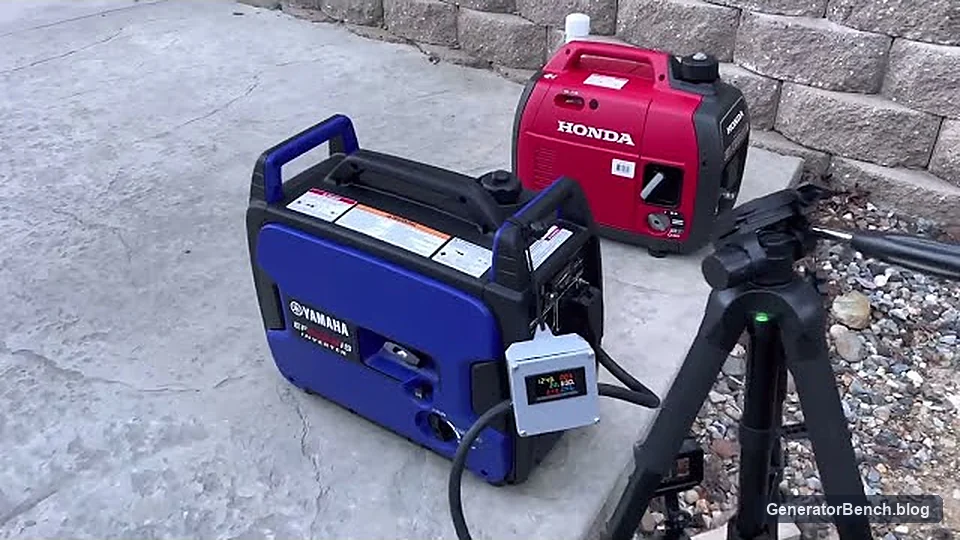
Conversely, our Honda EU2200i review highlights an advanced 121cc commercial-grade engine that maximizes thermal efficiency. This larger displacement allows rapid recovery when heavy inductive loads suddenly engage.
The Yamaha features a 79cc overhead valve single-cylinder engine designed for high volumetric efficiency. Its internal combustion chamber geometry promotes complete air-fuel mixing under varying mechanical loads and ambient temperatures.
Honda counters with a 121cc overhead cam GXH125 engine, yielding higher torque reserves. This displacement advantage allows the Honda unit to handle sudden mechanical block loads with minimal momentary engine speed droop.
- Yamaha displacement sits at 79cc for compact sizing.
- Honda features a larger 121cc commercial motor.
- Both provide clean sine wave power for electronics.
Torque Delivery and Surge Management
Managing starting watts requires precise governor tuning and robust flywheel momentum. Both machines handle brief electrical spikes exceptionally well, protecting sensitive RV air conditioners during compressor startup cycles.
Engineers designed these inverters to throttle smoothly under load, minimizing voltage drops that could potentially damage connected computers, medical devices, or modern refrigeration compressors.
- Smooth electronic throttling reduces voltage sag.
- Flywheel design assists with momentary surge demands.
Connected Power Delivery and Sensitive Electronics
Modern digital infrastructure demands ultra-clean electricity with minimal harmonic distortion. Both portable inverter generators produce total harmonic distortion of less than three percent, safeguarding your sensitive microprocessors.
Whether you are powering entertainment systems or charging critical communication tools on site, clean power delivery prevents hardware degradation over thousands of operating hours.
Both inverters utilize sophisticated pulse-width modulation microprocessors to convert raw alternating current into stable direct current and back. This ensures a pure sine wave output with minimal total harmonic distortion.
Sensitive laboratory instruments and medical devices operate safely on these waveforms because harmonic distortion remains below two percent. Overload protection circuits trip instantly if short-circuit conditions threaten the inverter module.
- THD remains safely below three percent on both models.
- Inverter modules condition raw AC power efficiently.
- Protected outlets resist dust and moisture intrusion.
Digital Interface and Circuit Protection
Control panels feature integrated overload alarms, output indicator lights, and eco-throttle switches. These intuitive layouts help operators monitor machine status instantly without guessing internal temperatures.
Circuit breakers trip reliably during severe faults, protecting internal alternator windings from thermal overload and costly electrical failures during emergency field operations.
- Clear visual LED indicators show operational status.
- Manual reset breakers prevent secondary component damage.
Ergonomics, Frame Design, and Portability
Transporting heavy fuel-filled equipment requires thoughtful handle placement and balanced weight distribution. The Honda boasts a noticeably lighter dry weight, making single-handed carrying much less fatiguing during trips.
As outlined in our Yamaha EF2200iS review, the brand counters with a multi-handle configuration facilitating cooperative lifting and secure tie-down placement, though its overall footprint feels bulkier in tight storage spaces.
Carrying comfort relies heavily on the integration of balanced handle geometry and robust housing polymers. The Yamaha utilizes a tri-handle configuration that facilitates secure two-handed lifting during transport operations.
Honda incorporates a single centered bail handle molded directly into the upper resin casing. This structural approach optimizes one-handed carrying balance while reducing overall exterior dimensions for tight vehicle storage.
- Honda dry weight is approximately eight pounds lighter.
- Yamaha utilizes multiple grab points for team lifts.
- Compact outer shells fit neatly inside camper compartments.
Chassis Durability and Housing Materials
Impact-resistant polymer resins protect internal components from accidental drops and harsh weather conditions. Reinforced structural frames absorb mechanical vibrations while maintaining rigid alignment for all moving parts.
Service panels offer quick access to spark plugs and air filters, simplifying routine field maintenance without requiring specialized mechanic tools or complete shell disassembly.
- Resilient resin plastics withstand jobsite impacts.
- Tool-free access panels speed up routine inspections.
Acoustic Engineering and Decibel Profiles
As noted in our Honda EU2200i generator review, campground standards mandate low noise emissions during operation. Honda achieves exceptionally low decibel ratings via enclosed mufflers and optimized cooling airflow paths.
Yamaha operates at slightly higher decibel levels under heavy loads, though its sound dampening foam absorbs high-frequency whines effectively, maintaining an acceptable acoustic profile during standard use.
Noise reduction depends on multi-chamber exhaust muffling and sound-dampening enclosure materials. Yamaha achieves a quiet running profile through optimized exhaust expansion chambers that attenuate high-frequency combustion noise effectively.
Honda utilizes a labyrinth-type cooling air intake and exhaustive sound-deadening foam lining inside the outer shell. Operating noise levels hover near fifty-three decibels at a standard distance of seven meters.
- Honda runs quieter at partial throttle settings.
- Yamaha utilizes dense acoustic baffling materials.
- Eco-modes reduce engine RPM when loads decrease.
Airflow Management and Thermal Suppression
Efficient cooling fans pull ambient air across the alternator windings and cylinder head without creating excessive mechanical noise. Proper thermal management prevents premature oil breakdown during prolonged summer runs.
Maintaining optimal operating temperatures directly extends overall engine longevity, reducing the likelihood of unexpected component warping or catastrophic thermal seizures in hot climates.
- Dedicated cooling ducts direct high-velocity airflow.
- Thermal sensors shut units down before overheating.
Fuel Efficiency and Extended Runtime Metrics
Fuel economy dictates how long your generator runs before requiring a refueling stop. Both units feature internal fuel shutoff valves that burn remaining carburetor fuel, preventing stubborn varnish buildup.
Running on eco-throttle mode significantly extends runtime by matching engine speed directly to electrical demand, conserving gasoline during low-draw overnight camping scenarios.
Efficient fuel consumption is governed by precise carburetor tuning and automated throttle governors. Yamaha incorporates an Eco-Throttle system that automatically adjusts engine speed to match the precise electrical load applied.
Following our Honda EU2200i break-in procedure, Honda features a comparable Eco-Throttle mechanism paired with high-compression combustion. This synergy allows extended operating intervals exceeding eight hours at a twenty-five percent continuous electrical load rating.
- Carburetor drain settings prevent stale fuel issues.
- Eco-throttle modes stretch single-tank operating hours.
- Fuel gauges provide accurate remaining volume estimates.
Carburetor Maintenance and Fuel Quality
Modern ethanol-blended fuels can quickly clog small jets if stored improperly. Keeping spare inline filters and utilizing fuel stabilizers ensures reliable starting performance after seasonal storage periods.
Draining the float bowl completely before long-term storage remains essential for preventing costly carburetor rebuilds and ensuring immediate ignition when emergency power is needed.
- Inline fuel filters catch microscopic tank debris.
- Fuel stabilizer use prevents ethanol gumming.
Maintenance Protocols and Long-Term Serviceability
Routine preventative maintenance guarantees reliable operation season after season. Checking engine oil levels before every startup is crucial for preventing internal scoring and bearing wear.
Spark plug inspections and air filter cleanings should follow manufacturer guidelines to maintain optimal combustion efficiency and prevent unnecessary fuel consumption during heavy workloads.
Routine service requirements dictate long-term ownership costs and overall machine reliability. Both units feature accessible side-panel maintenance doors for checking the spark plug and cleaning the polyurethane foam air filter.
Oil changes demand strict adherence to drain intervals to prevent premature cylinder wear. Utilizing synthetic lubricants with appropriate viscosity ratings ensures optimal thermal stability during high ambient temperature operating conditions.
- Daily oil level checks prevent catastrophic failures.
- Air filter cleanings maintain combustion efficiency.
- Spark plug gaps require periodic measurement checks.
Consumables Replacement and Spare Parts
Sourcing replacement filters, gaskets, and spark plugs remains straightforward for both brands through authorized dealer networks and online hardware suppliers, minimizing equipment downtime significantly.
Keeping a dedicated maintenance log helps track operating hours accurately, ensuring timely oil changes and preventative part swaps before minor wear turns into major mechanical failure.
- Authorized parts are widely available globally.
- Maintenance logs track total operating hours.
Frequently Asked Questions
Can I run sensitive medical equipment using these generators?
Yes, both models feature advanced inverter modules that produce clean sinusoidal power with very low harmonic distortion. This ensures safe operation for computers and medical devices without unexpected voltage spikes.
How do I connect two identical units for double the power?
You can easily link matching generators using an approved parallel cable kit plugged into dedicated front panel ports. This safely combines electrical output without risking internal alternator damage or electrical shock hazards.
What type of engine oil is recommended for extreme weather?
Most manufacturers recommend synthetic 10W-30 oil for general ambient temperatures, but switch to 5W-30 during freezing winter conditions. Always verify your specific user manual before filling the crankcase.
Why is my generator surging when electrical loads are applied?
Engine surging usually indicates a partially clogged carburetor jet or stale fuel restriction in the fuel line. Running fresh fuel with a quality stabilizer typically resolves minor governor hunting issues.
How should I store the generator during the off-season?
Drain all remaining gasoline from the fuel tank and carburetor float bowl completely to prevent varnish deposits. Store the unit in a clean, dry indoor space with a breathable protective cover.